






Charging the pitch: Inside the World Cup’s radically redesigned smart ball
The 2022 FIFA World Cup featured battery-powered soccer balls that needed charging on the sidelines. For the upcoming tournament, adidas’ new Trionda Pro ball keeps the plug-in feature but introduces a complete internal redesign that will transform how we watch the game.
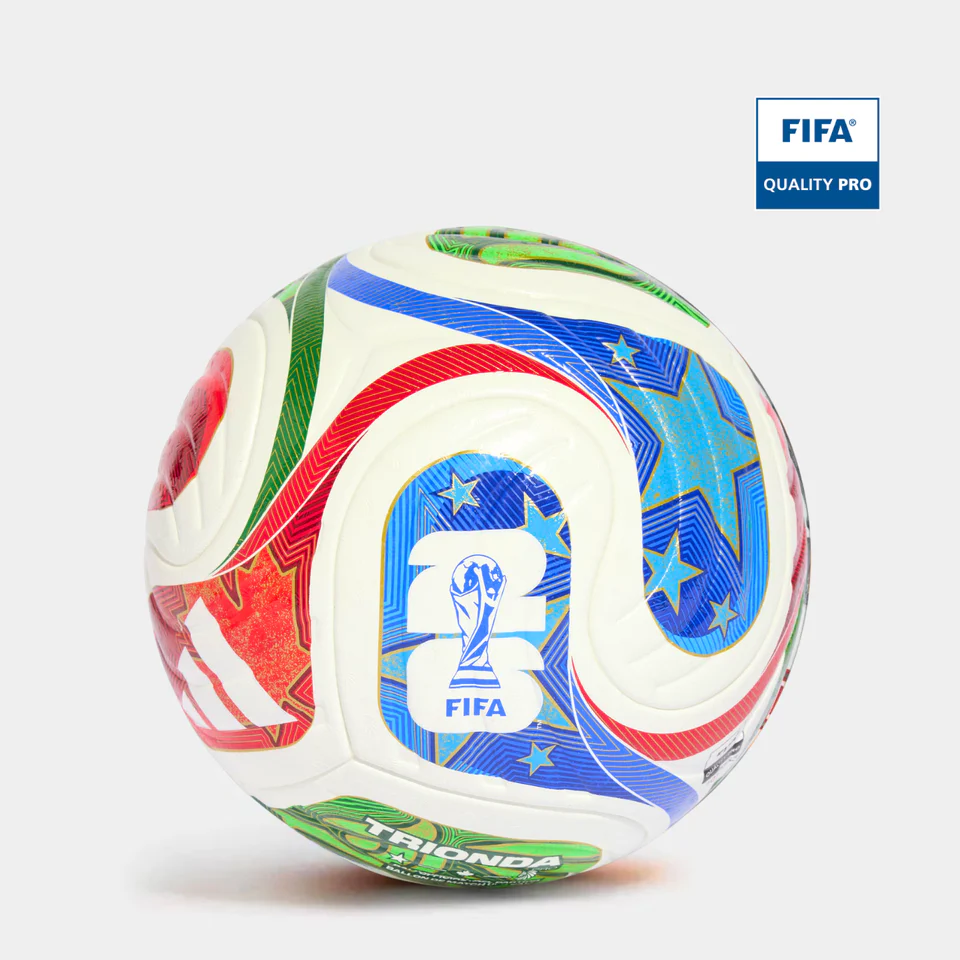
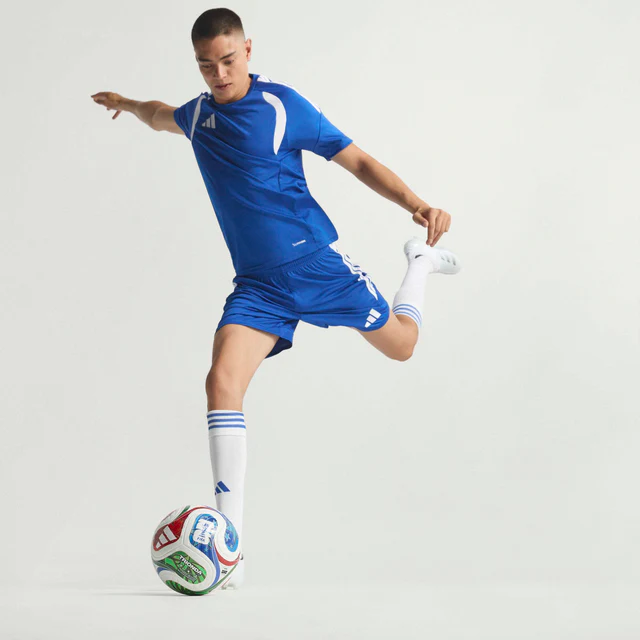
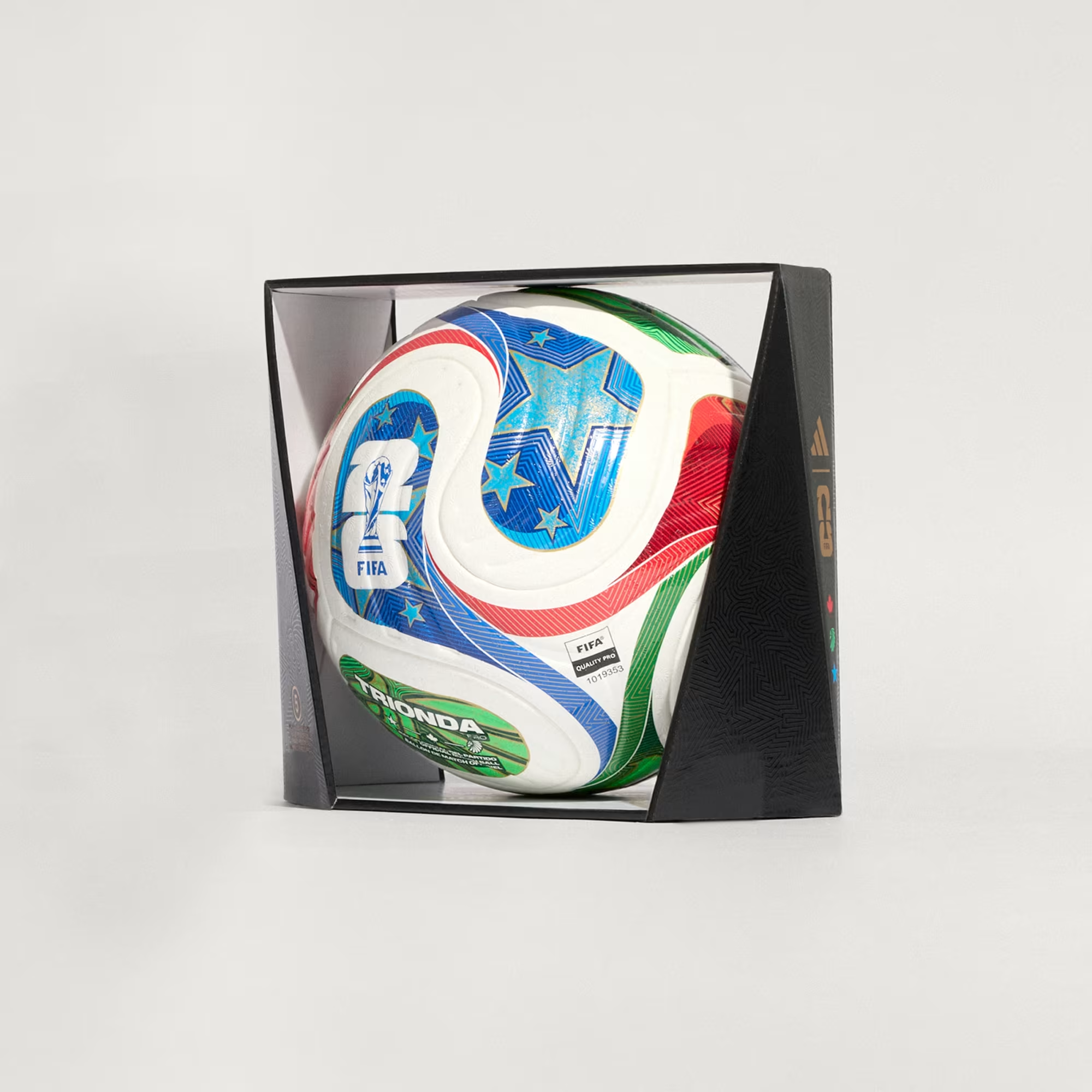
If you watched the 2022 World Cup in Qatar, you might remember the viral photos of soccer balls plugged into power strips on the sidelines. It felt like science fiction, but a battery-powered match ball was the new reality. For the upcoming tournament, having to charge the soccer ball is nothing new. But what is new is how adidas has completely ripped apart the inside of the ball and rebuilt it. The new match ball, the Trionda Pro, keeps the plug-in convenience of its predecessor but introduces a risky, brilliant engineering overhaul that will change how we watch the game.
What this means for the fans (and the referees)
Before we dive into the circuit boards, let’s talk about what this ball actually does for the game. No one wants technology to slow down football, and the Trionda Pro is designed to do the exact opposite.
By feeding real-time data directly to the Video Assistant Referee (VAR) room, this ball acts as an automated truth-teller on the pitch. Here is how it upgrades the fan experience:
Goodbye, endless offside delays
The ball syncs with 12 overhead stadium cameras tracking 29 points on every player’s body. The second a boot touches the ball, the system knows. This creates an automated 3D offside line in seconds, eliminating those agonising minutes spent watching refs manually scrub through broadcast footage frame by frame.
Settling ghost goals and handballs
Did it cross the line? Did it graze a defender’s fingertips? The internal tech detects the exact millisecond and force of any impact, giving refs objective data to make instant calls on controversial moments.
Video game-style broadcasts
For the tech nerds and stats geeks, the ball turns live matches into a data goldmine. During replays, TV graphics will instantly overlay stats like “127 km/h shot velocity” or “2,400 RPM backspin,” letting you see exactly how much bend a player put on a free kick.

The tech inside: Moving the brains to the danger zone
So, how does it work? At the heart of the Trionda Pro is an Inertial Measurement Unit (IMU) motion sensor chip. This tiny, 14-gram package contains the chip, a transmission radio, and a rechargeable battery that lasts for six hours of active use.
The sensor operates at a blistering 500Hz, meaning it records and transmits data 500 times per second (once every 2 milliseconds).
The Engineering Gamble: Centre vs. Perimeter
While the 500Hz speed is the same as the 2022 ball, where that sensor lives is a total engineering rethink.
In 2022, adidas played it safe. They used a web of tension wires to suspend the 14-gram sensor dead in the exact geometric centre of the ball. This kept the weight perfectly balanced so the ball flew straight.
For the new ball, adidas abandoned the centre entirely. They tucked the sensor into a pocket built directly into one of the outer panels.
To a physicist or a player, this sounds crazy. Shifting 14 grams to the outer edge of a spinning sphere is like a figure skater throwing their arms out mid-spin – it radically alters the rotation. If the ball is unbalanced by even a fraction of a millimetre, it will wobble in the air, bounce unpredictably, and feel completely “wrong” to world-class football players.
The fix: Precision counterweights
To pull off this reckless design, adidas engineers built mechanical counterweights into the other three outer panels. By perfectly distributing this dead weight across the rest of the sphere, they neutralised the imbalance. The result? A uniform “moment of inertia,” meaning the ball flies, spins, and bounces identically no matter which panel a player strikes.
Fewer panels, better physics
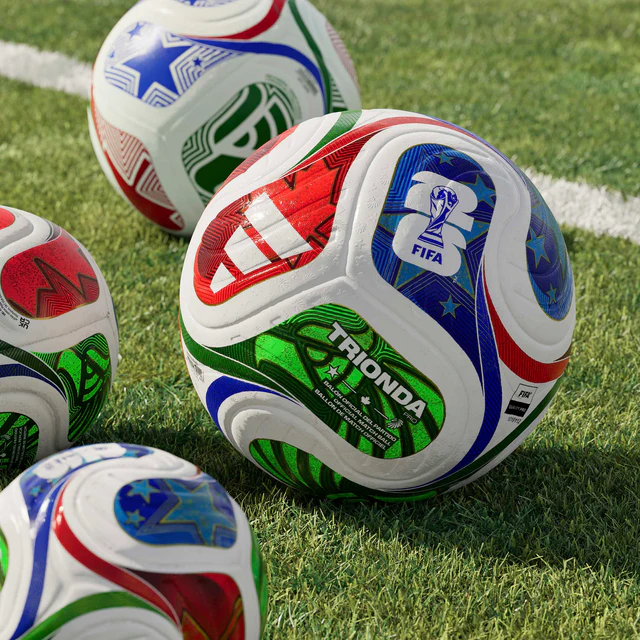
The innovation doesn’t stop on the inside. The exterior of the ball has been reduced from 20 panels in 2022 to a minimalist, thermally bonded four-panel geometry.
Historically, fewer panels mean erratic flight paths (anyone remember the infamous, unpredictable 8-panel Jabulani ball from 2010?). To stop the Trionda Pro from dancing unpredictably in the air, adidas added two key features to the polyurethane outer layer:
- Deep macro-seams between the four panels.
- Debossed micro-textures across the surface.
These surface textures manage the airflow around the ball, ensuring it flies true whether it’s being kicked in the high altitude of Mexico City, the humidity of Miami, or the chill of Toronto.
Visually, the ball wraps all this tech in tricolour wave patterns and geometric motifs that celebrate the three host nations: the USA, Canada, and Mexico.
By figuring out how to mount sensors directly onto the outer shell without ruining the flight of the ball, adidas has paved the way for more durable tech, multi-sensor setups, and even deeper analytics in the future.
The future of the beautiful game
The evolution of the World Cup match ball proves that football equipment is no longer just leather and air – balls are now moving data nodes in a massive stadium intelligence network. By figuring out how to mount sensors directly onto the outer shell without ruining the flight of the ball, adidas has paved the way for more durable tech, multi-sensor setups, and even deeper analytics in the future.
But for now, the most high-tech tournament in history still relies on one very basic rule: someone in the stadium tunnel has to remember to plug the soccer balls into the wall before kick-off.
Price
You can buy the adidas Trionda Pro for around R2699 in South Africa and a replica training ball (without the tech) for around R699.
This article was not sponsored and contains no affiliate links. All opinions expressed are those of the editorial team.
Also read
Apple’s double launch: Should you upgrade to the iPhone 18 Pro now, or wait for the Duo?
Gerda Engelbrecht Apple has shaken up its traditional September release schedule, delivering not one but two distinct flagship experiences: the photog...

The art of decanting: The smart way to serve wine at its best
Gerda Engelbrecht We tested a temperature-controlled decanter from Solenco and it solved one of wine service’s most annoying problems. If you’ve e...
I tested the Garmin Edge 1050 over 230 km (and 17 and a half hours) and this is why I love it…
How the Garmin Edge 1050 (a.k.a.