

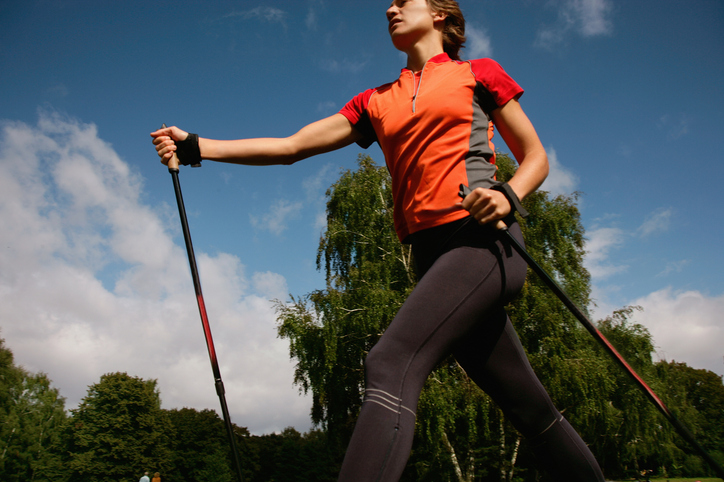
Getting Fit? Do it the Nordic Way!
Forget about expensive gym memberships or complicated fitness regimes. There’s a simple, effective, and enjoyable way to transform your fitness, Nordic walking!
Nordic walking has its roots in Finnish culture, where it began as “sauvakävely” (“pole walking”) in the 1930s. Originally developed as a summer training method for cross-country skiers, the technique allowed athletes to maintain their fitness during the off-season when snow wasn’t available. Finnish ski coach Leena Jääskeläinen is often credited with formalizing the modern technique in the 1990s, transforming what was once an elite training method into an accessible fitness activity for everyone.
The practice gained international recognition in the late 1990s and early 2000s, spreading rapidly across Europe before making its way to other continents. Today, Nordic walking boasts over 10 million enthusiasts worldwide, with dedicated associations in more than 40 countries. What started as a practical solution for Finnish athletes has evolved into one of the world’s fastest-growing fitness activities, proving that sometimes the simplest ideas create the most lasting impact.
The Science-Backed Health Revolution
Nordic walking isn’t just a casual stroll with poles – it’s a powerhouse workout that delivers impressive health benefits backed by extensive research. Studies consistently show that Nordic walking burns up to 46% more calories than regular walking while increasing heart rate by 10-15 beats per minute. This efficiency comes from the fact that Nordic walking activates approximately 90% of your body’s muscles, compared to just 70% engaged during regular walking.
The cardiovascular benefits are particularly compelling. Regular Nordic walking sessions significantly improve cardiovascular endurance, reduce blood pressure, and enhance circulation throughout the body. Meanwhile, the upper body engagement strengthens arms, shoulders, chest, and core muscles in a way that traditional walking simply cannot achieve.
Perhaps most importantly for many fitness enthusiasts, Nordic walking is incredibly joint-friendly. The poles reduce impact on knees, hips, and ankles by up to 30%, making it an ideal exercise for people with arthritis, joint concerns, or those recovering from injuries. This low-impact nature means you can maintain consistency in your fitness routine without the wear and tear associated with high-impact activities.
The mental health benefits shouldn’t be overlooked either. The rhythmic nature of Nordic walking, combined with outdoor exercise, provides significant stress reduction and mood improvement through endorphin release. When practiced in groups, it becomes a social activity that combats isolation while promoting mindfulness through the focus required for proper technique.
What do you need to get started?
One of the greatest barriers to starting any new fitness activity is often the initial equipment investment. Fortunately, Nordic walking’s equipment requirements are refreshingly simple.
The beauty of Nordic walking lies in its accessibility. All you truly need are poles, comfortable walking shoes with good grip, appropriate clothing for the weather, and a water bottle.
Can you use “regular” hiking poles for Nordig walking?
While hiking/trekking poles and Nordic walking poles may look similar, they’re designed for different purposes with distinct features. Hiking poles are typically adjustable in length to accommodate uphill and downhill terrain, feature traditional grips with simple wrist straps, and are held more vertically to provide stability and balance on uneven trails. They come with various interchangeable tips and larger baskets for different surfaces like rocks, mud, or snow.
In contrast, Nordic walking poles are usually fixed-length and sized to your height, equipped with specialised glove-like straps that allow you to release and re-grip with each stride, and are designed to be held at a more acute angle, planted behind you to propel yourself forward.
Nordic walking poles have smaller, angled rubber tips optimized for pavement and smooth surfaces, and their primary purpose is fitness walking that engages upper body muscles and increases calorie burn. Essentially, trekking poles are about stability and support on trails, while Nordic walking poles are about propulsion and full-body fitness on relatively flat surfaces.
But if you want to give Nordic walking a go, you can start with your regular hiking poles and upgrade later.
Most hiking poles sold in South Africa already come equipped with the essential features needed for Nordic walking. They have adjustable lengths, rubber tips suitable for pavement walking, and comfortable grip handles. This means you can start your Nordic walking journey with equipment that’s readily available at outdoor stores across the country at a fraction of the cost of imported Nordic walking-specific gear.
The recommended approach is to start with quality hiking poles and see how much you enjoy the activity. If Nordic walking becomes a regular part of your fitness routine – which it very likely will – you can then consider upgrading to specialised Nordic walking poles with ergonomic glove-type straps for enhanced performance and technique refinement.
Mastering the Technique
While Nordic walking may look deceptively simple, proper technique is crucial for maximizing benefits and preventing injury. The foundation begins with setting your pole length correctly. Stand upright holding the pole, and adjust it so your elbow creates a 90-degree angle when the pole tip touches the ground. This typically works out to about 68% of your height, though beginners should start slightly shorter to build confidence and coordination.
The Nordic walking stride builds upon natural walking movements but with enhanced coordination and purpose. Begin by standing tall with poles at your sides, arms relaxed, and poles angled slightly backward. Always look ahead rather than down at your feet or poles.
The walking motion involves stepping forward naturally with your left foot while simultaneously swinging your right arm forward, planting the pole near your foot. Keep your arms relatively straight but not rigidly locked, and maintain a longer stride than you would during normal walking. This creates the characteristic Nordic walking rhythm that becomes second nature with practice.
The push-off phase is where Nordic walking truly distinguishes itself from regular walking. As your right foot steps forward, push back powerfully with your left arm, driving the pole backward past your hip. If you’re using hiking poles, maintain your grip but focus on pushing through your palm and fingers. With specialised Nordic walking poles, you can release your grip at the end of the push-off, allowing for a more fluid motion.
The key to success lies in coordination and rhythm. Your opposite arm and leg should work together harmoniously – left arm with right leg, creating a natural cross-pattern movement. Land on your heel and roll through to your toe with each step, keeping poles close to your body rather than allowing them to swing wide.
Remember that technique development takes time. Start slowly, focusing on coordination before speed. Keep poles planted behind you rather than in front of your feet, engage your core muscles as if pulling your belly button toward your spine, and breathe rhythmically to match your stride pattern.
Begin with sessions lasting 20-30 minutes, focusing entirely on coordination and technique rather than speed or distance. Choose flat, safe routes such as parks, promenades, or quiet residential areas while you’re building confidence.
During your first two weeks, don’t worry about speed or intensity. The goal is to develop the coordination between arms and legs while becoming comfortable with the poles. Many beginners find it helpful to practice the arm motions while standing still before attempting to walk.
As you progress into weeks three and four, gradually increase session duration to 30-45 minutes and begin incorporating gentle inclines and varied terrain. This is also an excellent time to seek out local walking groups or Nordic walking clubs, as learning from others can accelerate your technique development significantly.
Your path to Nordic walking success can start immediately. This week, try the basic technique with any poles you have available, or even practice the arm motions without poles. In a few months you’ll likely find yourself fitter, stronger, and healthier than you’ve been in years.
The best exercise is always the one you’ll consistently perform, and Nordic walking’s combination of effectiveness and enjoyment makes it an ideal choice for anyone ready to embrace a healthier 2026. So grab those poles, step outside, and discover why millions of people worldwide have fallen in love with this Finnish fitness phenomenon. Your body, mind, and fitness goals are waiting!
Also read
The 37.5 fabric is a game-changer for more than just athletes
Gerda Engelbrecht Whether you’re pushing through a HIIT session, tackling weekend trails, or managing the unpredictable temperature swings of menopa...

Pieter-Steph’s 100th Test commemorated with special jersey and cap
Cape Union Mart celebrates Pieter-Steph du Toit’s 100th Bok Test with a special jersey and cap.

The Canon PowerShot V1 is a lot of camera for not a lot of money
Gerda Engelbrecht Released in April 2025, the Canon PowerShot V1 might not be the newest camera on the market, but with current discounts making it mo...