


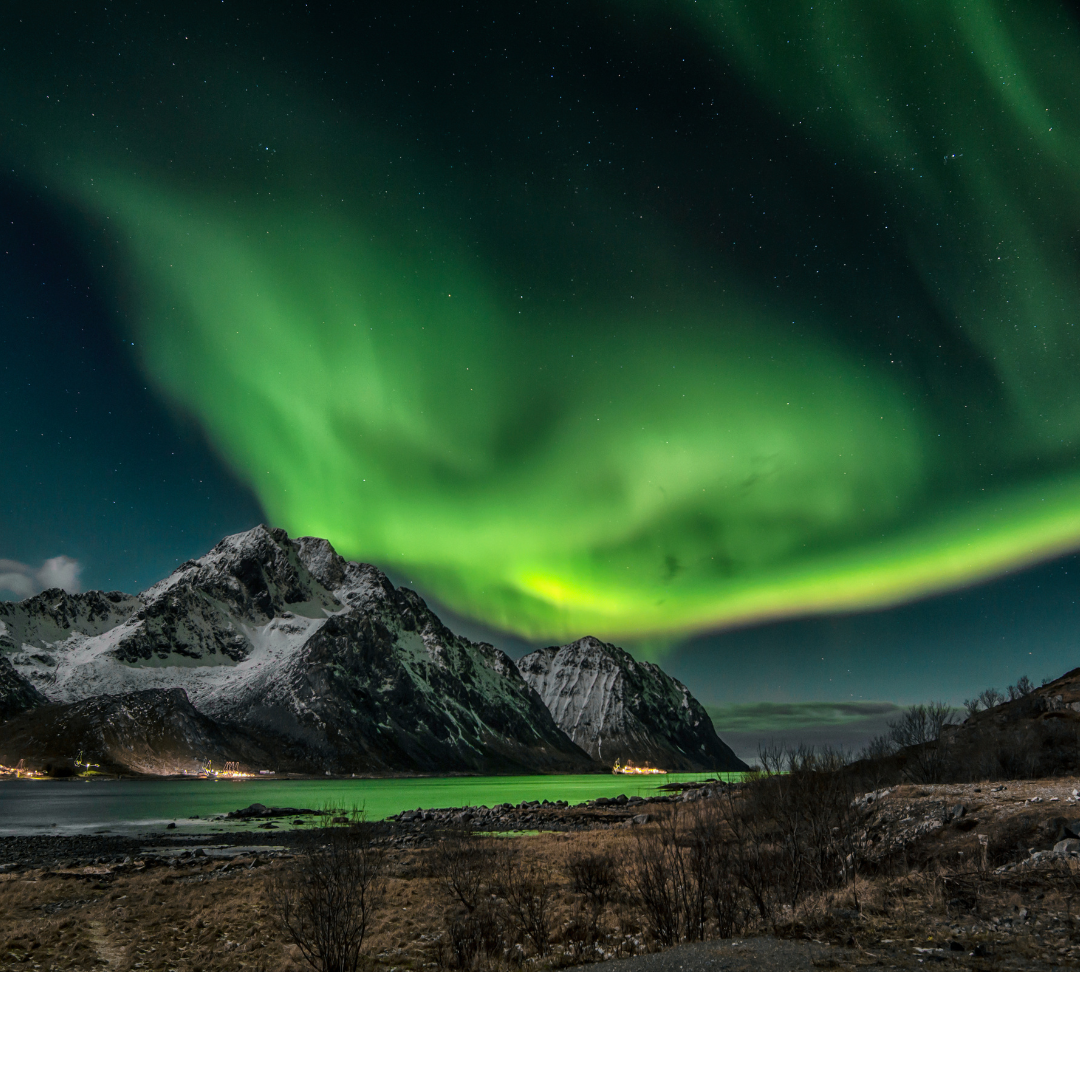
Capturing the Cosmic Dance: A Complete Guide to Photographing the Northern Lights
To take good photos of the Aurora Borealis, you need good equipment, the right technique, and lots of patience. Here’s everything you need to know.
What equipment do you need?
- Camera: Full-frame cameras perform better in low light, but APS sensor cameras (“crop sensors”) also take excellent photos. It’s important that you can adjust the camera manually – so it can’t be a point-and-shoot. The camera must have a high ISO (3200 will be good). It would be a bonus if the camera is weather-resistant. The camera must be able to keep its shutter open indefinitely – look for a B (“bulb mode”) in its settings, or it must be compatible with a remote shutter release.
- Lens: You need a wide-angle lens with a large aperture (f/2.8, f/1.8, or f/1.4). Good options are the Canon RF 15-35mm f/2.8, Nikon Z 14-24mm f/2.8, or Sony FE 16-35mm f/2.8.
- Tripod or bean bag so your camera can stand perfectly still for long periods. A carbon fiber tripod is a good investment because it’s light and durable. Make sure the tripod can carry at least 1.5x the weight of your camera and lens.
- Remote shutter release for your camera. If you use the shutter on your camera, it’s very difficult to keep the camera completely still.
- Extra batteries – batteries drain extra quickly in the cold. Carry the extra batteries on your body to keep them warm
- Weather-resistant clothing: gloves with fingertips that still allow you to adjust your camera, boots, good jacket
How to do it
- Set your camera to M (manual).
- Choose your largest available aperture (e.g., f/2.8).
- Start with an ISO of 800 – you can increase the ISO later if you don’t get clear photos. If the ISO is too high, the photo will be grainy.
- Set the shutter speed. Start with a speed between 10 and 20 seconds. Or use the remote shutter to keep the shutter open even longer.
- Focus by setting the lens to infinity.
- Set the white balance to daylight or auto.
Top tips
- The best time of day to photograph the Northern Lights is usually between 22:00 and 02:00.
- Monitor the app to see when solar activity is at its best.
- Look for interesting elements in the foreground, like trees or mountains, or static objects like shipwrecks that can give the photo depth. Experiment with a person standing with a headlamp about 100 meters from the camera.
- Use the rule of thirds, but place the light over two-thirds of the photo
- Take multiple photos. The first few might not be brilliant. Keep the shutter open for longer periods.
- Protect yourself and your equipment in the cold. You’ll be outside for long periods and need extra layers of clothing. Protect your camera by wrapping it in plastic if it’s humid outside.
- Be patient.
REMEMBER
Condensation damages your camera! The buildings in those regions have air conditioning that keeps the heat inside the building at summer temperatures. Protect your camera from condensation by gradually exposing it to the warmer building. Carry a ziplock bag in your jacket pocket and place your camera inside the bag before entering a building. Keep the camera under your jacket for a minute or two when you enter so it can gradually warm up.
Equipment Investment
Lenses
You’ll need a wide-angle lens with a large aperture. It’s a big bonus if the lens is weather-protected. These lenses are usually made of glass and therefore more expensive.
Examples of lenses that will work:
- Canon EF 16-35mm f/2.8L III USM
- Canon EF 24mm f/1.4L II USM
- Nikon AF-S NIKKOR 14-24mm f/2.8G ED
- Nikon AF-S NIKKOR 20mm f/1.8G ED
- Sony FE 16-35mm f/2.8 GM
- Sony FE 24mm f/1.4 GM
- Fujifilm XF 16mm f/1.4 R WR
- Fujifilm XF 10-24mm f/4 R OIS WR
Tripod
Look for something that’s sturdy but still light. Check the tripod’s load capacity and calculate whether it can carry your camera + lens. If your tripod falls over in the snow, your equipment is probably gone with it.
Manfrotto Element MII (aluminum)
Price: R3395 at Orms
Remote Control
Make sure the remote controller works with your camera.
Hahnel remote controller for Canon
Price: R625 at Orms
This is a comprehensive guide for Aurora Borealis photography with detailed technical specifications and practical advice!
Sources:
- The Aurora Guy – Camera Gear Recommendations
- Photography Life – How to Photograph Aurora Borealis
- Capture the Atlas – Northern Lights Photography
- Adorama – Cold Weather Camera Protection
- Multiple professional
Also read
The 37.5 fabric is a game-changer for more than just athletes
Gerda Engelbrecht Whether you’re pushing through a HIIT session, tackling weekend trails, or managing the unpredictable temperature swings of menopa...

Pieter-Steph’s 100th Test commemorated with special jersey and cap
Cape Union Mart celebrates Pieter-Steph du Toit’s 100th Bok Test with a special jersey and cap.
The Canon PowerShot V1 is a lot of camera for not a lot of money
Gerda Engelbrecht Released in April 2025, the Canon PowerShot V1 might not be the newest camera on the market, but with current discounts making it mo...