


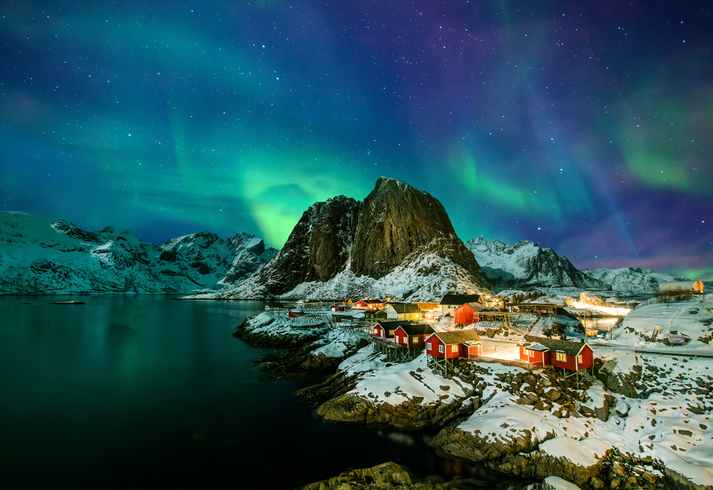
Experience nature’s green spectacle – experience the Northern Lights
The Aurora Borealis is truly a breathtaking experience – nature’s annual fireworks display. However, from now until March 2026, there is a special reason to try to see it.
The Aurora Borealis, or the Northern Lights, is a natural phenomenon that decorates the night sky in bright shades of green, red, pink and purple. It is one of those natural phenomena that one simply must see once in your life. Unfortunately, it is also quite fickle and unpredictable, and many travellers have stories of how they went to the expense of travelling to the corners of the world but ended up not seeing the Northern Lights.
The good news, however, is that the Northern Lights are currently (and until early 2026) at their best in more than a decade. The sun’s activity is in an 11-year cycle, and 2024 is the peak of the cycle, the so-called solar maximum. During this time, the sun is more active and releases more solar wind particles, which affects the intensity and frequency of the Northern Lights. This means that the area in which they are seen is also larger. It is therefore possible that in the next few months you will be able to see the Northern Lights further south. The next solar maximum is not expected until 2036 or 2037.
Best places to see the Northern Lights
- Iceland. It’s not a cheap destination, but it’s one that will take your breath away. Frozen waterfalls, black sand beaches, hot springs the size of rugby fields, geothermal geysers that shoot boiling water floors high into the air, ice caves . . . Iceland offers much more than just the Northern Lights! And the people are hospitable and friendly. Rent an apartment for a few nights in Reykjavik and then somewhere in the countryside, like the town of Vik or near the Jökulsárlón glacier lagoon and rent a car to drive around. Cook your own food from their supermarkets. (Salmon is very affordable in Iceland.) Iceland is about 103 000 square kilometres (smaller than the Free State) and the roads are easy to navigate. From Reykjavik, you can go on organised tours to see the Northern Lights, but your best chance is in the countryside, where there is little man-made light.
- Norway. The further north you go, the better your chances. From Oslo, you can take a connecting flight to Tromso, or you can take the longer and more scenic route there. Take the train from Oslo to Bergen (one of the most spectacular train routes in the world), and in Tromso, board a ship that takes you through the fjords to Tromso (and beyond). Save money by booking with the ferry company Hurtigruten (www.hurtigruten.com). Hurtigruten is so confident that you will see the Northern Lights on board that they promise you an extra free trip if you don’t see them during your 11-day cruise! The boat stops at other beautiful places along the way, such as Trondheim and the Lofoten Islands. Tromso itself is a little paradise where you can go dog sledding. However, remember that if you want to take spectacular photos of the Northern Lights, a boat is not the best option because the boat doesn’t stand still enough.
- Finland. The Lapland region, especially around Rovaniemi, is excellently located for the Northern Lights. Rovaniemi is also known as the official home of Santa Claus. Fly into Helsinki and take the overnight train to Rovaniemi. Besides the Northern Lights and Christmas Village, you can also ride snow quad bikes and go on an icebreaker boat tour where you float in protective clothing in the icy water. (It’s more fun than it sounds.)
- Iceland, Finland and Norway are the most common places, but there are other options too. Consider the town of Abisko in Sweden; the Yukon, Northwest Territories or Nunavut in Canada.
Top tips
- The best months to go are October to March, which are the cold months in these regions.
- Arrange accommodation in a combination of urban and rural areas because the Northern Lights are better visible in the countryside.
- You’ll need a good jacket and shoes. In South Africa our choices are limited because we see little snow. Look out for:
- boots with grooves on the soles because snow becomes slippery when temperatures fluctuate,
- underlayers and socks made of pure wool
- a jacket that can work in conditions below freezing
- a wool hat and scarf.
- Download a mobile phone app like “Aurora Forecast” that will show you when the Aurora Borealis is best visible.
What causes the Northern Lights?
The sun emits small particles called the solar wind. These particles travel through the atmosphere and sometimes reach the Earth. The Earth has a magnetic field that protects us from these harmful particles, but in the vicinity of the North and South Poles this magnetic field is at its weakest. When the solar wind particles reach the gas in the Earth’s atmosphere, it creates energy, which is emitted as light. It is that light that we observe as the Aurora Borealis.
The history of the phenomenon
The Aurora Borealis has fascinated people for centuries. The first written references to this come from China and date back to the 10th century BC. An entry in the so-called Bamboo Journals, which recorded the reign of King Zhao, the fourth king in the Zhou dynasty, refers to a five-coloured band in the sky observed in the north. Researchers suspect that this may be an observation of the Aurora Borealis. In ancient China, such phenomena were seen as harbingers of bad news and a message from heaven.
In Norse mythology, the Northern Lights were seen as the reflection of the shields of the Valkyries, the mythological women who accompanied fallen warriors to Valhalla. Indigenous groups, such as the Inuit and the Sámi (the inhabitants of Lapland), believed that they were the ancestors communicating with them.
The first attempt to understand it scientifically was probably by the French scientist Pierre Gassendi, who coined the term Aurora Borealis in 1621. The name combines the name of the Roman goddess of the dawn (Aurora), with the Greek name for the north wind, Boreas.
It was Edmund Halley (the man of Halley’s Comet) who first suggested in the 18th century that the phenomenon was related to the interaction between the Earth’s magnetic field and the atmosphere.
Also read
The 37.5 fabric is a game-changer for more than just athletes
Gerda Engelbrecht Whether you’re pushing through a HIIT session, tackling weekend trails, or managing the unpredictable temperature swings of menopa...

Pieter-Steph’s 100th Test commemorated with special jersey and cap
Cape Union Mart celebrates Pieter-Steph du Toit’s 100th Bok Test with a special jersey and cap.

The Canon PowerShot V1 is a lot of camera for not a lot of money
Gerda Engelbrecht Released in April 2025, the Canon PowerShot V1 might not be the newest camera on the market, but with current discounts making it mo...